
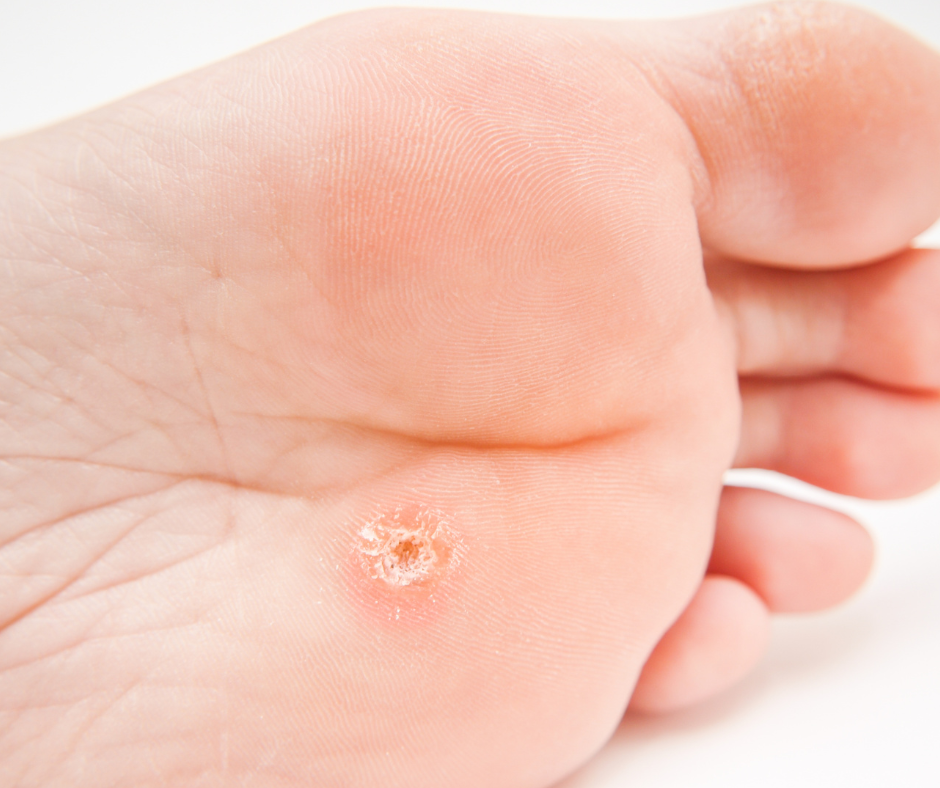
Is It Just a Summer Callus, or Is It a Plantar Wart?
After two solid months of walking barefoot at the community pool, running through neighborhood splash pads, and utilizing public locker rooms, the late-summer bill for barefoot exposure has finally arrived. At the Reconstructive Foot & Ankle Institute, August brings many patients dealing with stubborn, contagious Plantar Warts.
The biggest challenge? Patients frequently misdiagnose the problem, assuming the hard bump on the bottom of their foot is just a standard summer callus. Here is exactly how to tell the difference between the two…and why treating a wart like a callus is a terrible idea.
Decoding the Bump on Your Foot
Plantar warts are caused by the Human Papillomavirus (HPV).
- Because the virus thrives in warm, damp environments, public pool decks and shared showers are the ultimate breeding grounds.
- When the virus enters through a microscopic scratch on the bottom of your foot, it creates a hard, rough growth.
- Because you are constantly walking on it, the wart is pushed inward, and your body builds a thick layer of skin over it.
To the untrained eye, it looks exactly like a normal, friction-induced callus.
Here’s the thing: warts have their own blood supply.
- If you look closely at the bump, you will often see tiny, pinpoint black dots inside the rough skin. These are clotted capillary blood vessels.
- Additionally, a callus usually hurts when you press directly on it, while a wart will cause sharp pain if you squeeze it from the sides.
Why DIY Treatments Spread the Virus
If you mistake a wart for a callus and take a pumice stone or a metal foot file to it, you will not remove it.
- Instead, you will tear open the infected tissue and actively spread the viral spores across the rest of your foot.
- Similarly, over-the-counter pharmacy acid pads are often too weak to penetrate the thick skin on the bottom of the foot, frequently resulting in painful chemical burns on your healthy skin without killing the virus.
Professional Eradication
If you are dealing with plantar warts, stop guessing and let the experts handle it.
- We can accurately diagnose the growth and use cantharone treatments to deal with the problem.
- This natural treatment is derived from a South American blistering beetle.
- By causing your body to attack the cantharone that’s causing the blistering, we can guide your immune system to the warts.
- We apply cantharone right here in our office, and about 11 days later, follow-up is scheduled to ensure the issue does not recur.
Clear up your skin before the fall routines begin. Reach out today and get ready to experience clear skin again!
Like Dr. Michaels says:
If It’s Below the Knee, Think of Me!
Reconstructive Foot & Ankle Institute, LLC offers comprehensive podiatric services. Call us at 301-797-8554 or contact us to schedule an appointment. Located in Hagerstown & Frederick, MD, we’re ready to meet any of your foot health needs.
